Pre-position your teams before impact
Geolocated storm alerts on your intervention zones, not across the whole department.
What a storm does to fire-and-rescue services: a brutal surge in load
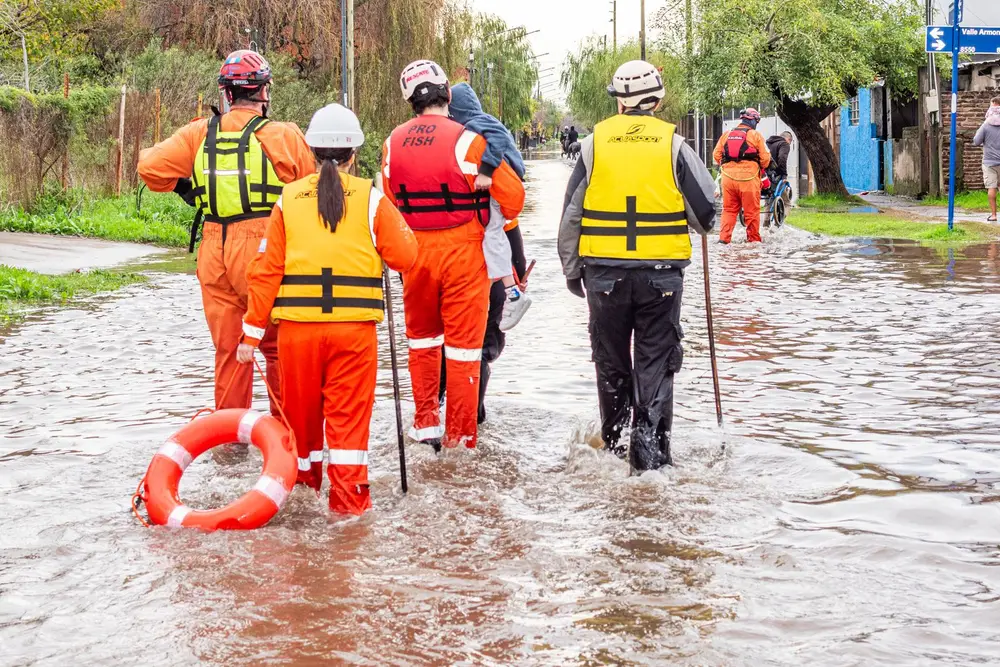
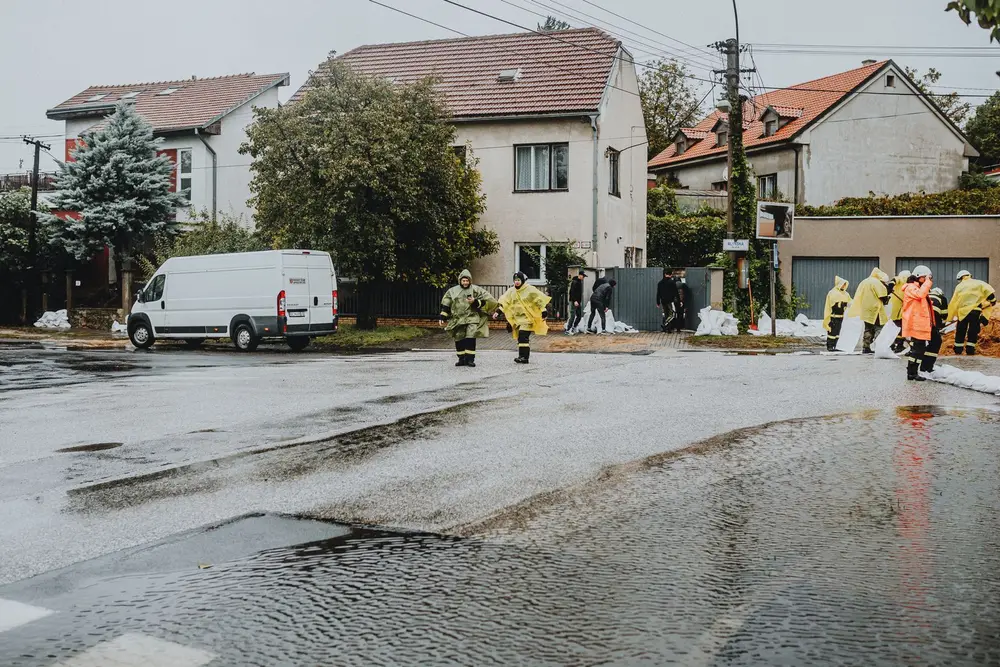
A violent storm isn't a localized event. It is a chain of consequences that snowballs in a matter of tens of minutes: trees on vehicles, flooded basements, power cuts, road accidents on soaked surfaces, roofs damaged by hail, fires started by lightning strikes.
The figures speak for themselves. During the summer 2025 storms in the Allier, the SDIS 03 received more than 160 calls in the space of three hours, between 7pm and 10pm. The final toll: several hundred interventions, reinforcements from 22 SDIS across France, a Paris fire brigade and two army regiments mobilized for the post-event response. In Eure-et-Loir, during a June 2025 episode, the SDIS 28 reached 220 interventions in a single evening.
These activity peaks aren't anomalies. They are operational realities that fire-and-rescue services face every season. The question isn't whether these episodes will recur. It is how to prepare for them.

The problem with current alerts: useful for the public, insufficient for operations
The weather tools available for free were designed to inform the general public and administrative authorities at the department scale. They fill that role perfectly. But they don't meet a fire-and-rescue service's operational needs.
Unsuitable scale
An orange warning covers a whole department, sometimes several thousand km². A convective storm episode rarely hits more than a band 10 to 30 km wide.
Too short a lead time
Warning bulletins are updated every 6 hours. To plan pre-positioning, activate on-call duty or alert volunteers, you need several hours of lead time.
No trajectory
Knowing a storm is likely isn't enough. Will it pass over the northern sector or the southern one? The deployment decision remains impossible without a trajectory.
What Storm Predict changes for fire-and-rescue services
Geolocated alerts on your intervention sectors
You set up your priority monitoring zones as independent spots. Storm Predict tracks storm cells in real time and triggers an alert only when a phenomenon genuinely threatens a precise zone, with accuracy under 10 km.
The operations centre can distinguish a cell that will hit the northern part of the department from another that will only cross the coastal sector. Resources aren't mobilized the same way depending on the actual geographic risk.
Predictive trajectories up to 4 hours
Storm Predict computes the forecast trajectory of identified storm cells up to 4 hours ahead, drawing on the steering winds and vertical shear, not on a simple extrapolation of the current position.
A confidence index is shown in real time for every trajectory. Storm Predict doesn't claim absolute precision: convective weather carries inherent uncertainty. But the information always comes with a reliability indicator to help operational managers calibrate their decision.
Automatic classification of phenomena
Not all storms pose the same risks to rescue operations.
Direct risk to personnel on outdoor interventions, to electrical infrastructure, potential for fires to start.
Damage to vehicles and infrastructure, a surge of calls for damaged roofs.
Trees on roads, fallen cables, road obstructions, risks to personnel in the open.
Concrete use cases for fire-and-rescue services
Preventive pre-positioning
With an alert 3 to 4 hours before impact on a defined sector, it becomes possible to reposition vehicles from less exposed stations toward stations closer to the identified risk zones. This pre-positioning reduces response time during the intervention peak, which generally occurs within 30 to 60 minutes after the cell passes.
Activating reinforcements and on-call duty
Fire-and-rescue services have gradual escalation protocols. Activating the higher on-call levels takes time to implement. A precise, early alert makes it possible to start this process in time, rather than triggering it in an emergency under the pressure of the first calls.
Protecting personnel on interventions
Lightning strikes between 100 and 300 people a year in France according to Météorage, with about 10 to 15 deaths annually. Personnel intervening in open spaces are exposed if a second storm episode approaches after the first. Knowing precisely whether a new cell is following within 90 minutes changes the safety protocol for teams in the field.
Volunteers and early mobilization
The vast majority of French fire-and-rescue services operate with a large share of volunteer firefighters. Putting volunteers on alert early, made possible by precise weather information, significantly increases the effective mobilization rate at the peak.
Integration into a fire-and-rescue service's organization
Storm Predict complements the existing weather tools, adding the layer of geographic and temporal precision that general-purpose alerts lack. The dedicated dashboard lets several operational managers monitor the situation on their respective sectors at once.
For services that want integration into their existing systems, Storm Predict is developing a documented REST API to retrieve data in real time and feed it into command environments (Enterprise offer).
Service limits
Storm Predict is not a general-purpose weather-forecasting service. It does not replace Météo-France bulletins for public communication. It does not guarantee absolute precision on trajectories. What it brings is the best geolocated information available, early enough to make sound organizational decisions.
Summary of benefits
Storm Predict for fire-and-rescue services
- Alerts on your configured sectors, not on the whole department
- Geographic accuracy under 10 km
- Predictive trajectories up to 4 hours
- Classification by phenomenon type: lightning, hail, gusts
- Real-time confidence index on every trajectory
- Dashboard shareable among several managers
- Alert history for post-event reviews
- API available for command-system integration (Enterprise)
Let's talk about your operational constraints
Every fire-and-rescue service has its own organization, its high-stakes sectors, its protocols. A 30-minute call is usually enough to see how Storm Predict fits into your existing setup.