Protect your wind farms, anticipate shutdowns
Geolocated alerts on each farm, not across the whole region. Preventive-shutdown decisions based on precise data.
Storm exposure: a structural reality for renewable-energy farms
Wind turbines and solar farms share a feature that sets them apart from most other industrial installations: by definition, they are sited in the open, on often exposed terrain, across surfaces that can span dozens of hectares. This exposure is the condition of their operation. It is also their main vulnerability to extreme weather.
Storms are a threat on several levels: direct lightning on equipment, surges induced by nearby strikes, wind gusts exceeding operational safety thresholds, and risks to maintenance crews in the field.
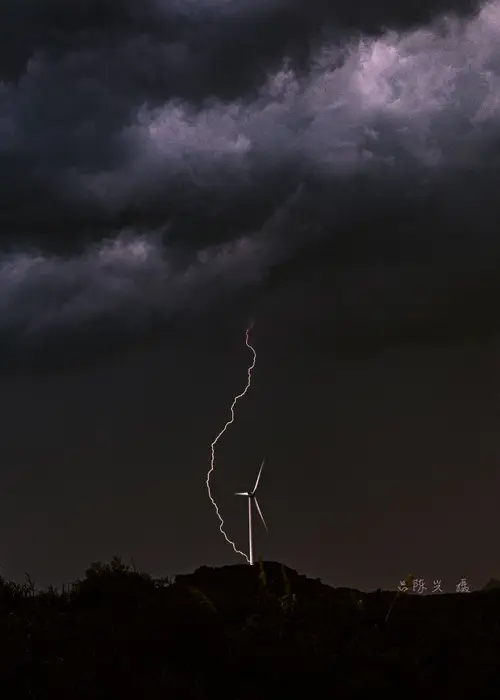
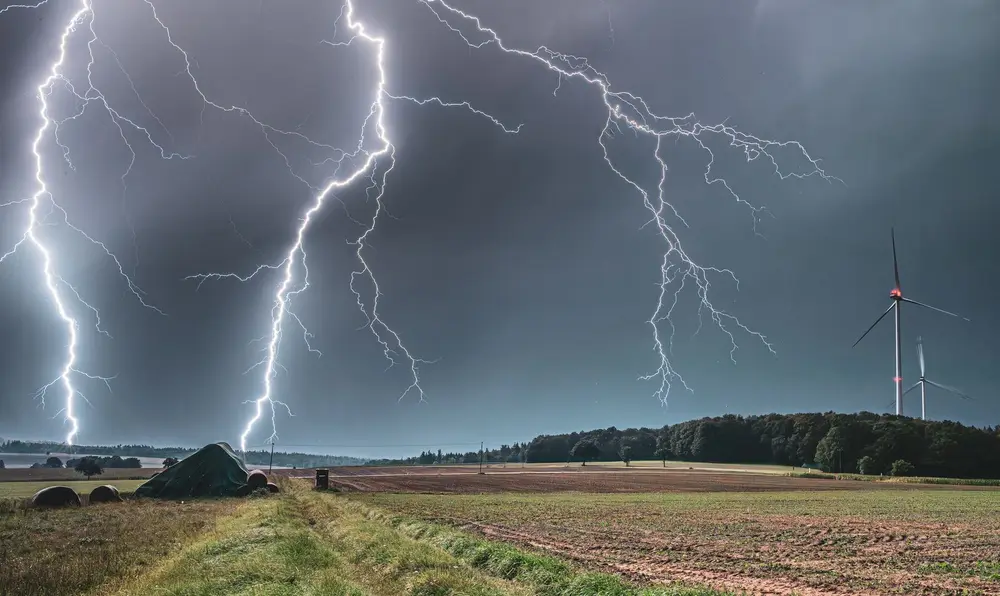
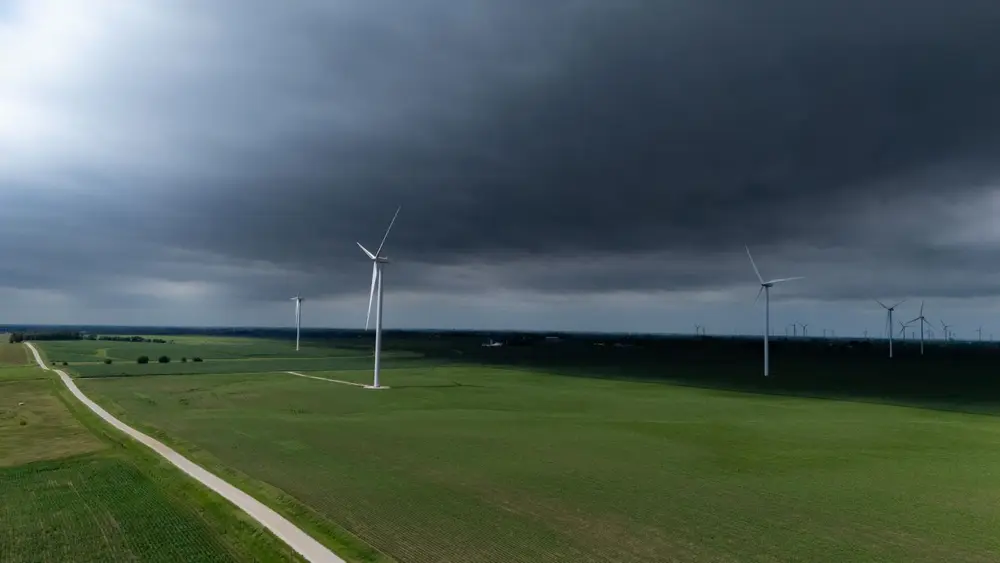
Lightning on wind turbines: a documented, costly risk
Lightning accounts for 6% of wind-turbine shutdowns according to data published on wind-power accidents in France (ARIA database, Ministry for the Ecological Transition). The figure may look modest in proportion, but set against the number of installations and the duration of the resulting downtime, it represents a significant operating cost.
Damage from a lightning strike on a turbine varies with intensity and point of impact. Documented incidents include blade tears several metres long, the destruction of electrical cabinets and damage to surge-protection systems. One referenced incident reports a 94 kA strike that tore a blade over 6 metres, requiring replacement of all three blades and several weeks of downtime.
Turbine blades are among the most expensive components to replace, and the work requires specialized crews whose mobilization times can stretch over several weeks. Lost production adds to the repair costs.
The preventive-shutdown dilemma
Managing lightning risk for a wind-farm operator rests on a constant trade-off between protecting assets and optimizing output. Shutting a turbine down preventively has a cost in lost production. Not shutting it down exposes the equipment to potentially far costlier damage.
With today's general-purpose alert tools, this decision is often made out of an abundance of caution, resulting in shutdowns on farms that weren't actually on the trajectory. Storm Predict provides the geographic and temporal precision to make that trade-off rational.
Wind farms
Preventive shutdown targeted at exposed machines, protection of maintenance crews, real-time cell tracking.
Solar farms
Surges on inverters from nearby strikes, hail risk on panels, gust thresholds for certain structures.
Maintenance crews
Scheduling interventions around risk windows, early evacuation of personnel working at height.
Multi-farm management: the challenge for large operators
An operator running dozens of farms spread across several French regions faces an information problem at scale. Storms don't respect administrative boundaries. One episode can threaten farms in Occitanie and Nouvelle-Aquitaine at once while leaving installations in Brittany untouched.
Storm Predict lets you set up all your farms as independent monitoring spots. The centralized dashboard tracks each installation's risk status in real time and helps prioritize preventive-shutdown decisions.
ICPE compliance and lightning traceability
For installations subject to authorization under the ICPE regime, the order of 19 July 2011 requires systems that record storm activity with timestamps, for a systematic check of protections after any episode. Storm Predict keeps a timestamped, geolocated history of every alert issued for each configured spot, usable as part of these traceability obligations.
Service limits
Storm Predict is not a lightning-protection system. It does not replace the surge-protection systems fitted to turbines or the post-storm inspection procedures of installations. A confidence index is shown on every predictive trajectory.
Summary of benefits
Storm Predict for the energy sector
- Geolocated alerts on each farm configured as a monitoring spot
- Differentiation between lightning, gusts and hail
- Predictive trajectories up to 4 hours with a confidence index
- Accuracy under 10 km
- Centralized multi-farm dashboard
- Timestamped alert history for ICPE compliance
- API for SCADA and supervision-tool integration (Enterprise)
Let's talk about your farms and operational constraints
Every operator has its own profile, geographic spread and maintenance constraints. A 30-minute call is enough.